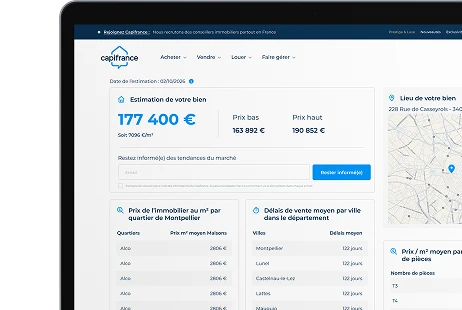






Your valuation may be lower than it was a year ago even in a sought-after neighbourhood, because a popular area does not protect against changes in buyers' purchasing power. In 2026, mortgage rates have risen (average rate of 3.51% over 20 years in November), the supply of properties for sale has increased, buyers negotiate almost systematically (4.8% average discount) and signed prices for existing homes are edging down (-0.8% over one year according to notaries). Factors specific to your property may also come into play: DPE (energy performance certificate), co-ownership works, competition from similar listings, or an earlier valuation that was too optimistic.
In summary
- A neighbourhood's appeal does not prevent prices from adjusting when borrowing costs more.
- A reliable valuation is based on signed prices, which reflect negotiation, rather than on asking prices.
- DPE, service charges, approved works and local competition can weigh on a specific property.
- Ask for the sales references used: they explain the gap.
The 6 reasons for a lower valuation
1. The cost of borrowing has increased
Between November 2025 and November 2026, the best 20-year rate went from 2.99% to 3.20% and the average rate exceeds 3.50%. The 10-year OAT passed 5% in October and the European Central Bank raised its rates in September, as stated in its official press release of 10 September 2026. With equal incomes, buyers in your neighbourhood can borrow a little less. To measure the effect of these factors on your property, request an updated property valuation.
2. Signed prices are edging down
The Notaires-Insee indices show -0.8% over one year for existing homes and -1.3% for houses. Even in Paris, where prices are stabilising, the cumulative correction since the 2023 peak is close to 12%.
3. Negotiation has become the norm
Nine out of ten sales are negotiated. A valuation based on signed prices is mechanically lower than an asking price.
4. More competition in your neighbourhood
If several comparable properties are for sale at the same time, buyers have a choice and prices adjust, including in sought-after areas.
5. Factors specific to your property
An unfavourable DPE, a façade renovation or roof repair approved by the co-ownership, higher service charges or a new overlooking building can weigh on the value.
6. An earlier valuation that was too optimistic
A valuation carried out without a visit, or based on asking prices, may have overvalued the property. The gap then reflects a correction in methodology more than an actual drop.
A point of caution: the valuation method
A valuation based on asking prices, on old sales or on too broad a geographical area can be misleading in both directions. When you compare two valuations carried out a year apart, check that they rely on the same method: signed sales, genuinely comparable properties, a recent period.
Sought-after neighbourhoods are not spared by cycles
Even the most sought-after areas go through adjustment phases. In Paris, where demand remains very strong, prices fell by around 12% between the 2023 peak and 2026, before stabilising. In the sought-after neighbourhoods of large regional cities, adjustments have been more moderate, but real.
Sought-after neighbourhood: what holds up and what adjusts
What holds up | What adjusts |
|---|---|
The number of viewings and buyer interest | The maximum price buyers can finance |
Rare properties (view, outdoor space, top floor) | Standard properties facing competition |
Small, well-located properties | Large properties with a high budget |
Properties in good condition with a good DPE | Properties needing works or with an F or G rating |
The role of local demand
In a sought-after neighbourhood, there are still plenty of viewings, but buyers are more selective. They compare more, negotiate more and favour properties that need no renovation work. A property that ticks all the boxes still sells well; a property with a flaw is penalised more harshly than before.
What to do when faced with a lower valuation?
Ask for the references
A serious valuation is based on recent comparable sales. Ask for them and check that they concern genuinely similar properties. Also compare them with the properties for sale in your neighbourhood, which represent the current competition.
Compare several reasoned opinions
A second opinion can confirm the trend or reveal an overlooked factor. However, be wary of a significantly higher valuation that comes without justification.
Act on what is within your control
Updating the DPE (energy performance diagnostic), notably with the new calculation method on 1 January 2027 for homes heated by electricity, minor works, careful presentation: these levers can recover part of the gap.
Decide according to your plans
If you are buying again in the same neighbourhood, the drop also works in your favour on the purchase. If you are in no hurry, you can wait, bearing in mind that no quick rebound is guaranteed.
Compare with the price of your next purchase
If you are selling in order to buy, ask your adviser to also estimate how prices are changing in the area where you want to buy. If both markets have fallen by the same proportions, the gap between your sale and your purchase remains stable: the drop in your valuation then has no real effect on your plans.
Do not confuse value with purchase price
Some owners refuse to sell below the price they paid or a previous valuation. This benchmark is understandable, but it does not necessarily correspond to the current value. The market does not take into account the price the seller paid, only what today's buyers can and want to pay.
Example: an apartment valued 6% lower in one year
A concrete case helps to understand how several factors add up. The figures are indicative.
The 2025 valuation
A 70 m² three-room apartment (T3) in a highly sought-after neighbourhood of a large city is valued at €350,000 in autumn 2025, based on sales signed in the first half of 2025, at a time when interest rates were slightly lower and the recovery in transactions was strong.
The 2026 valuation
A year later, the adviser values it at €329,000. The reasons: four comparable apartments are currently for sale in the neighbourhood, compared with only one last year; the last two sales signed closed at around €4,700/m² after negotiation; the co-ownership (copropriété) has voted for a façade renovation, part of which will remain the seller's responsibility; the DPE, rated E, weighs more heavily in buyers' decisions.
Breakdown of the gap
Factor | Estimated effect |
|---|---|
Change in signed prices in the neighbourhood | -1 to -2% |
Increased competition from similar listings | -1 to -2% |
Voted co-ownership works | -1 to -2% |
2025 valuation based on more optimistic prices | -1% |
What the owner can do
Check the effect of the new DPE calculation on 1 January 2027 if the apartment is heated by electricity, negotiate with the buyer over who bears the cost of the façade renovation by adjusting the price, and position the property slightly below competing properties to attract buyers. In this scenario, a quick sale at around €330,000 is more favourable than an uncertain wait.
Should you sell, wait or add value to your property?
A lower valuation does not by itself dictate the decision. Three options are open to you, depending on your situation.
Sell at the current market price
This is the best option if you have a project (purchase, job transfer, need for cash) or if you are buying again in the same area, where you will also benefit from more negotiable prices. A property priced correctly in a sought-after neighborhood generally sells quickly. A Capifrance advisor in your area can help you weigh these options.
Wait
This is a possibility if you have no project and your property is not at risk of losing value for other reasons (DPE energy performance rating, renovation work). But there is no guarantee of a quick rebound: forecasts for 2027 point instead to stability, with rates that could still rise.
Add value before selling
Minor work, an improved DPE rating, home staging, a complete file: these actions can make up for part of the gap. They are particularly useful when the drop in valuation is due to factors specific to the property rather than to the market.
The Expert's View
"Seeing their valuation fall while their neighborhood remains in demand is often hard for owners to accept, and I understand that. But I explain to them that a sought-after neighborhood guarantees demand, not a price. The price is set by buyers, based on what they can finance and what they find elsewhere. In 2026, they are borrowing at slightly higher rates, they have more choice, and they negotiate almost systematically. So for every valuation, I show the sales that have been signed in the neighborhood, the competing properties for sale, and how long they have been on the market. With these elements, the gap becomes understandable and the decision simpler. In most cases, a property priced correctly in a good neighborhood sells quickly, and the seller recovers that gap when buying their next home. What costs a lot is denying reality and sitting in the shop window for months."
— Frédéric Rémy, Commercial Performance Director at Capifrance
Conclusion
A falling valuation in a sought-after neighborhood is most often explained by the credit market, the widespread practice of negotiation, and local competition, and sometimes by factors specific to the property. Understanding the gap, by asking for the reference sales, allows you to decide with confidence: sell at the right price, add value to your property, or wait.
Get an up-to-date, well-reasoned opinion with a free property valuation, compare with properties for sale in your neighborhood, and talk to a Capifrance advisor in your area. Are your neighbors wondering too? Recommend them by becoming a Capifrance business referrer.
FAQ - Frequently Asked Questions
My neighborhood is in demand, so why are prices falling?
Because the price also depends on what buyers can finance. When rates rise, their budget falls, even if demand remains strong.
Will my valuation rise again in 2027?
That will depend mainly on credit rates. The most likely scenario is stability, with local adjustments.
Can an online valuation explain the gap?
Yes, if one of the valuations was based on outdated data or asking prices rather than recent signed sales.
Should I refuse to sell below last year's valuation?
It is not a good benchmark: only the current market price matters if you want to sell within a reasonable time.
Do valuations vary from one agency to another?
Yes, depending on the references used and each person's experience. Always ask for the comparable sales that justify the figure proposed.
Can a valuation rise again within a few months?
Yes, if you improve the property (DPE rating, renovation work) or if the local market recovers, for example after a drop in rates. Have it updated before putting the property on the market.
Can the new 2027 DPE raise my valuation?
If your home is electrically heated and close to a threshold, a better rating can reduce the energy-related discount and improve the valuation.
Should I change agencies if I am disappointed with the valuation?
Comparing several opinions is legitimate, but choosing the professional who quotes the highest figure often leads to an overvalued property that does not sell. Favour the best-argued estimate.
Does a lower estimate affect my current loan?
No, the value of your property has no effect on an existing mortgage, except in the case of a renegotiation or loan buyback (credit consolidation) where the bank may take it into account.
How long does an estimate remain valid?
In a changing market, an estimate that is more than three to six months old should be updated before any sale.
Should I have my property valued every year?
It is not mandatory, but an annual estimate lets you track the evolution of your assets and decide at the right time on a sale or renovation project.
Author
Frédéric Rémy – Director of Sales Performance

A real estate professional with several years of experience within the Capifrance network, I would like to share essential advice with you to help you successfully complete your property project with our advisors.