

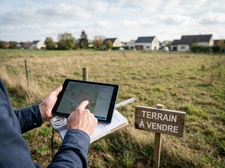




Setting the right price for land for sale is a technical exercise that cannot be improvised, because poor pricing can just as easily put off buyers as cost you several thousand euros. In 2026, the average price of building land in France ranges between 90 and 150 euros per m², with considerable differences between Île-de-France and rural regions. Buildability, utility connections, surface area, orientation and easements are all criteria that can make the value of the same plot vary by a factor of two. This article details the complete method for valuing building land or non-buildable land and selling it at the fairest price.
In summary
- The price of a plot of land depends above all on its buildability under the PLU (local urban plan), its utility connections and its location.
- The price-per-m² method, cross-checked against DVF data and comparable listings, makes it possible to obtain a realistic range.
- Boundary marking (bornage) and a soil survey secure the transaction and reassure the buyer about the actual buildability.
- Using a professional for a property valuation helps avoid over- or undervaluing your property.
Understanding the criteria that determine the value of land
Before setting a price, it is essential to understand the parameters that cause the value of land for sale to vary. Land has no fixed intrinsic value: it results from the combination of its location, its legal status and its physical characteristics.
Buildability, the first factor of value
Building land is inherently worth more than agricultural or natural land, because it confers the right to build a house or carry out any other property project. The price difference between the two categories can reach a ratio of one to ten depending on the municipality.
Location and land pressure
Proximity to shops, schools, transport and employment areas directly influences the price per m². The more new residents an area attracts and the scarcer buildable land is there, the higher prices climb.
The price-per-m² method for valuing your land
The most widely used method for valuing land for sale consists of applying an average price per m² observed locally, then adjusting it according to the specific features of the plot.
Consulting average prices by region
In 2026, average prices for building land vary widely: around 290 euros per m² in Île-de-France compared with 60 euros per m² in Bourgogne-Franche-Comté, with the national average generally falling between 90 and 150 euros per m². These figures are only a starting point, to be refined with precise local data.
Using the DVF database for reliable comparables
The Demandes de Valeurs Foncières (DVF) database, published by the tax authorities, records actual transactions over the last five years, with the surface area and sale price. It allows you to compare your land with similar plots recently sold in your area, which remains the most objective method for refining a valuation.
The technical criteria that cause the price to vary
Beyond location, several technical criteria raise or lower the price of building land.
Utility connections on the land
Land with utilities (viabilisé), that is, connected or connectable to water, electricity, gas and sewerage, can command a significantly higher price than raw land. The cost of connecting utilities, which can amount to several thousand euros, must be anticipated by the seller in order to justify the sale price.
Orientation, surface area and topography
Good south or south-west orientation, a surface area that is neither too small nor oversized relative to the needs of the local market, and flat rather than sloping land are assets that increase attractiveness and therefore the price per m².
Easements and legal constraints
The presence of a right-of-way easement, a flood zone, a high-voltage line or an identified natural hazard can significantly reduce the value of land. These elements must absolutely be mentioned in the listing to avoid any later dispute with the buyer.
The Role of the PLU in Valuing Land
The Plan Local d'Urbanisme (PLU, the local urban planning document) is the reference document that determines whether a plot of land is buildable or not, and under what conditions.
Checking the Zoning at the Town Hall
A plot of land is considered buildable when the PLU classifies it as an urban zone (U) or a zone to be urbanised (AU). It is essential to consult the PLU at the town hall or on the public urban planning service website before setting a price, as this classification determines the entire transaction.
Planning Rules That Limit Buildability
Even when classified as buildable, a plot of land may be subject to strict rules: building footprint ratio (coefficient d'emprise au sol), maximum building height, and setbacks from property boundaries. These constraints reduce the building potential and must be factored into the price estimate.
Boundary Marking: A Key Step in Securing the Sale
Boundary marking (bornage) consists of precisely delimiting the boundaries of a plot of land by a géomètre-expert (a chartered land surveyor). Although not mandatory in every case, this procedure is strongly recommended before putting the property on the market.
Why Boundary Marking Reassures the Buyer
A plot with marked boundaries provides a legal guarantee of its exact surface area and property boundaries, which prevents any neighbourhood disputes after the sale. Buyers are generally willing to pay a higher price for a plot whose boundaries are clearly established.
The Cost and Process of Boundary Marking
Boundary marking is carried out by a géomètre-expert, and its cost varies depending on the size and complexity of the plot. This investment, paid by the seller or negotiated with the buyer, often pays for itself through a faster sale at a better price.
Anticipating the Tax Implications of Selling Land
The taxation of a plot of land indirectly influences its sale price, because an informed buyer will factor these costs into their negotiation.
The Development Tax (Taxe d'Aménagement)
The taxe d'aménagement (development tax) is payable by the purchaser when the building permit is obtained and is calculated on the taxable floor area of the future building. Although it is paid by the buyer, its amount is often raised during negotiations and may weigh on the price accepted for the land.
Notary Fees and Property Tax
Notary fees generally represent 7 to 8% of the price for an individual plot, compared with 2 to 3% for a plot located in a new subdivision (lotissement). The seller should also bear in mind that the owner of undeveloped land remains liable for the taxe foncière sur les propriétés non bâties (property tax on undeveloped land) until construction has actually taken place.
Calling on a Professional to Refine Your Estimate
Combining the figures with the on-the-ground expertise of a real estate professional remains the best way to set a fair and attractive price.
The Benefits of a Professional Valuation
A real estate advisor knows the prices actually achieved in the area, beyond statistical averages, and can identify the specific strengths or weaknesses of your plot. This expertise helps avoid the two classic pitfalls: overvaluation, which drives buyers away, and undervaluation, which causes the seller to lose value. To benefit from this support, you can find a real estate advisor near you.
Comparing with Local Market Listings
Browsing the property listings for similar plots of land for sale in your area allows you to check that your estimate is consistent with the current market supply, while bearing in mind that asking prices are not always the final sale prices.
Conclusion
Accurately valuing a plot of land for sale relies on cross-referencing several types of data: average prices per m² in the area, actual transactions from the DVF database, technical criteria such as utility connections (viabilisation) or orientation, and the regulatory framework set by the PLU. Boundary surveying (bornage), although it represents a cost, secures the transaction and reassures buyers about the exact surface area of the property. Finally, relying on the expertise of a real estate professional remains the most reliable way to obtain a price that is both fair and competitive, in order to sell under good conditions and within a reasonable timeframe.
The Expert's Perspective
"Valuing a plot of land is often more complex than valuing a built property, because owners lack reference points. Many sellers simply take the price per m² advertised by a neighbor, without taking into account utility connections, orientation or PLU constraints, and end up with a listing that stagnates for months. I systematically recommend checking the zoning at the town hall before putting anything on the market, because a plot classified as agricultural land is nothing like a building plot, even just a few hundred meters away. Boundary surveying is also a point that I advise never overlooking: a buyer who knows exactly what they are buying negotiates less and commits more quickly. Finally, the DVF database is a valuable tool, but it must always be supplemented by an on-site analysis, because two neighboring parcels can have very different values depending on their access, their shape or their soil type. It is this combination of figures and detailed knowledge of the local market that makes it possible to set a truly fair price, neither too high to discourage buyers, nor too low to sell off one's assets at a loss."
— Frédéric Rémy, Commercial Performance Director at Capifrance
FAQ - Frequently Asked Questions
How can I tell if my land is a building plot?
You need to consult the Local Urban Plan (Plan Local d'Urbanisme, PLU) at the town hall or on the public urban planning service website: a plot is buildable if it is classified as urban zone (U) or zone to be urbanized (AU).
What is the average price of a building plot in 2026?
The average price is generally between 90 and 150 euros per m² in France, with strong regional variations, ranging from around 60 euros per m² in some regions to nearly 290 euros per m² in Île-de-France.
Is boundary surveying mandatory before selling a plot of land?
Boundary surveying is not always mandatory, but it is strongly recommended in order to guarantee the exact boundaries of the land and secure the sale with respect to the buyer.
Who pays the development tax (taxe d'aménagement) on a plot of land?
The development tax is owed by the purchaser when the building permit is obtained, and not by the seller of the land.
How do I use the DVF database to value my land?
The DVF database records actual transactions from the last five years with the surface area and sale price, which makes it possible to compare your land with similar parcels recently sold in your area.
Author
Frédéric Rémy – Director of Sales Performance

A real estate professional with several years of experience within the Capifrance network, I would like to share essential advice with you to help you successfully complete your property project with our advisors.