







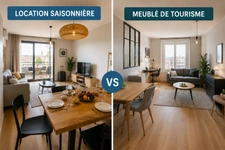

With the rise of rental platforms such as Airbnb, confusion between seasonal rentals and tourist furnished accommodation has become common. However, these two concepts refer to distinct legal realities that are essential to understand before getting started. This article helps clarify the differences between seasonal rentals and tourist furnished accommodation, detailing their legal, tax, and practical specificities for landlords and property investors in 2026.
To get precise answers to your questions regarding any sale, purchase, rental, or investment project, contact your local Capifrance real estate advisor.
Summary
- Seasonal rental refers to a short-term rental activity, while tourist furnished accommodation refers to the legal status of the property rented to temporary visitors.
- The main differences concern the length of stays, administrative requirements, possible property classification, and local regulations, particularly regarding primary residences and high-demand rental areas.
- In 2026, taxation differs significantly between classified and non-classified tourist furnished accommodation, with major differences in revenue thresholds and tax allowances depending on the applicable regime.
- Before renting out a property, owners must anticipate municipal formalities, registration numbers, change-of-use requirements in certain municipalities, and the management strategy best suited to their investment goals.
What Is a Seasonal Rental and a Tourist Furnished Accommodation? Definition
In everyday language, the terms seasonal rental and tourist furnished accommodation are often used interchangeably. However, these two concepts refer to distinct legal realities. To fully understand the obligations, tax advantages, and procedures applicable to your rental project, it is essential to understand the difference between these two terms. The distinction lies in the legal texts governing each activity.
Seasonal Rental: A Short-Term Rental Activity Governed by Law
Seasonal rental refers to the activity of renting out a property for short periods. According to Article 1-1 of Law No. 70-9 of January 2, 1970, known as the Hoguet Law, it is the rental of a property for a maximum non-renewable period of ninety consecutive days. This definition establishes a strict framework for the duration of each stay.
It is therefore a commonly used term describing the rental activity itself, regardless of the type of property involved. You may operate a seasonal rental using your primary residence, secondary residence, or an investment property, provided that individual stays do not exceed the 90-day limit for each tenant.
This form of temporary rental serves a transient clientele seeking accommodation for holidays, business trips, or short-term stays.
Tourist Furnished Accommodation: A Legal Status Defined by the Tourism Code
Tourist furnished accommodation, on the other hand, refers not to the rental activity but to the property itself. Article L324-1-1 of the French Tourism Code defines tourist furnished accommodation as furnished villas, apartments, or studios reserved exclusively for tenants and offered to temporary visitors who do not establish residence there. Rentals may be arranged on a daily, weekly, or monthly basis.
This legal status therefore applies to the property itself rather than to the duration of the rental. A tourist furnished accommodation may host guests for varying periods without a strict maximum stay, provided it caters to temporary visitors.
This classification also allows the property to obtain an official star rating (from 1 to 5 stars), certifying its level of comfort and amenities.
In summary, seasonal rental refers to the short-term rental activity, while tourist furnished accommodation refers to the type of property used for that purpose. The same property can therefore simultaneously be a tourist furnished accommodation (property status) and be offered as a seasonal rental (rental method).
What Are the Differences Between Seasonal Rentals and Tourist Furnished Accommodation?
Although these two terms are often confused, they refer to distinct concepts that are important to understand when managing a rental property. The first refers to a short-term rental activity, while the second refers to the property itself.
Rental Duration and the Concept of Long-Term Occupancy
As defined by the Hoguet Law, a seasonal rental is limited to a maximum of 90 consecutive days for the same tenant. This limitation aims to regulate short-term rental activities and prevent them from becoming traditional residential leases.
Tourist furnished accommodation, however, may be rented without a strict limit on the duration of individual stays, provided it serves a transient clientele that does not establish permanent residence.
The key difference lies in the nature of the property rather than the duration of each stay.
However, if you rent out your primary residence as tourist furnished accommodation, a specific rule applies: you may not exceed 120 rental days per year (some municipalities may reduce this limit to 90 days by local resolution). This measure helps preserve the traditional housing market while offering flexibility to owner-occupiers.
Seasonal Rentals and Airbnb: A Common Misunderstanding
Many people automatically associate Airbnb with seasonal rentals. However, Airbnb is merely an intermediary platform connecting property owners and tenants.
The property listed on Airbnb may be:
- A classified tourist furnished accommodation,
- A non-classified furnished accommodation,
- Or simply a room within a primary residence.
The platform itself does not determine the legal status of the property. That status depends on the nature of the accommodation, municipal registration requirements, any official classification, and the rental periods involved.
This distinction is important because it determines your administrative and tax obligations regardless of where your listing is published.
Landlord Obligations for Seasonal Rentals and Tourist Furnished Accommodation
Landlord obligations vary depending on the rental type, although some requirements apply in both cases.
In both situations, landlords must:
- Provide a detailed inventory and condition report;
- Draft a written rental agreement specifying the rental price and property description;
- Inform tenants about amenities and safety requirements;
- Collect tourist taxes where applicable.
However, tourist furnished accommodation is subject to additional requirements:
- Mandatory declaration to the municipality and acquisition of a registration number displayed on all listings;
- Compliance with enhanced safety standards (smoke detectors, compliant electrical installations);
- Eligibility for star classification;
- For newly rented tourist furnished accommodations since 2025, the property must achieve at least an Energy Performance Certificate (EPC/DPE) rating of E, with requirements progressively increasing to ratings A-D by 2034.
Seasonal rentals also require written agreements and property inventories but are generally subject to less restrictive classification and registration requirements depending on the municipality.
Comparison Table
Criterion | Seasonal Rental | Tourist Furnished Accommodation |
|---|---|---|
Definition | Short-term rental activity (Hoguet Law) | Furnished accommodation for temporary visitors (Tourism Code) |
Maximum Duration | 90 consecutive days per tenant | No strict limit (except primary residence: 120 days/year maximum) |
Legal Basis | Law No. 70-9 of January 2, 1970 | Articles L324-1 to L324-2-1 of the Tourism Code |
Star Classification | No | Yes (1 to 5 stars, optional) |
Typical Platforms | Airbnb, Abritel, Booking (intermediary tools) | Airbnb, Abritel, Booking (intermediary tools) |
What Tax Regime Applies to Tourist Furnished Accommodation and Seasonal Rentals in 2026?
Whether you occasionally rent out your primary residence or invest in tourist furnished accommodation, the income generated is taxed under the category of Industrial and Commercial Profits (BIC).
In 2026, two main tax systems coexist:
- The Micro-BIC regime
- The Actual (Real) Tax Regime
The Micro-BIC regime applies automatically if your annual rental income remains below certain thresholds.
For a classified tourist furnished accommodation, the annual threshold is €83,600. You then benefit from a 50% flat-rate allowance covering expenses and operating costs.
For a non-classified tourist furnished accommodation, recent tax reforms have significantly tightened the rules:
- Annual revenue ceiling limited to €15,000
- Flat-rate allowance reduced to 30%
Beyond this threshold, the actual tax regime becomes mandatory, requiring full accounting and generally higher administrative costs.
The actual tax regime allows you to deduct all actual expenses, including:
- Mortgage interest;
- Property tax;
- Insurance premiums;
- Management fees;
- Maintenance and repair work;
- Depreciation of the property and furnishings.
This regime can be more advantageous when actual expenses exceed the flat-rate allowance, especially for financed properties or those requiring substantial investment.
Author :

Frédéric Rémy – Director of Commercial Performance
A real estate professional for several years within the Capifrance network, I would like to share with you some essential advice to help you succeed in your real estate project with the support of our advisors.