









Information updated in July 2026.
Mortgage rates in August 2026: what impact will they have on your home-buying, selling or real estate investment project? Should you take advantage of the current conditions to borrow, or wait for the markets to move again before getting started? This article presents mortgage rates in August 2026, their levels and their impact on borrowing capacity. We detail the lowest rate, the average rate and the market rate scale, as well as financing options for your home loan rate in August 2026. You will find a data-based barometer, definitions, simulations and advice by borrower profile. For a personalised analysis, feel free to contact a Capifrance adviser.
In summary
Mortgage rates observed in August 2026 in France:
- Lowest rate — 10 years = 2.82%; 15 years = 3.00%; 20 years = 3.10%; 25 years = 3.20%;
- Average rate — 10 years = 3.02%; 15 years = 3.19%; 20 years = 3.31%; 25 years = 3.42%;
- Market rate scale — 10 years = 3.48%; 15 years = 3.71%; 20 years = 3.84%; 25 years = 3.98%.
Trend in August 2026: a slight easing in the best rates and average rates compared with July, while the catalogue rate scale remains stable. Keep a close eye on changes in French OAT government bond yields and ECB decisions.
Impact: a slight rebound in real estate purchasing power, adjustable through the loan term, personal contribution and insurance negotiation.
Recommended action:contact a local Capifrance real estate adviser to simulate your loan, compare APRs and be put in touch with a mortgage broker in order to obtain the best possible borrowing conditions.
Home loan rate barometer in August 2026: figures and tables
This monthly barometer provides a snapshot of the rates observed during the month across a national panel of banks and brokers. We distinguish between three types of rates: the lowest rate, the average rate and the market rate scale. The lowest rate corresponds to the best offers negotiated for strong borrower profiles. The average rate is the national average observed. The market rate scale reflects banks’ catalogue offers.
The methodology is based on a panel covering mainland France. It relies on public and professional sources such as the Observatoire Crédit Logement and the Banque de France. The scope includes mutual banks, retail banking networks and local brokers. The figures are updated monthly to enable tracking over time.
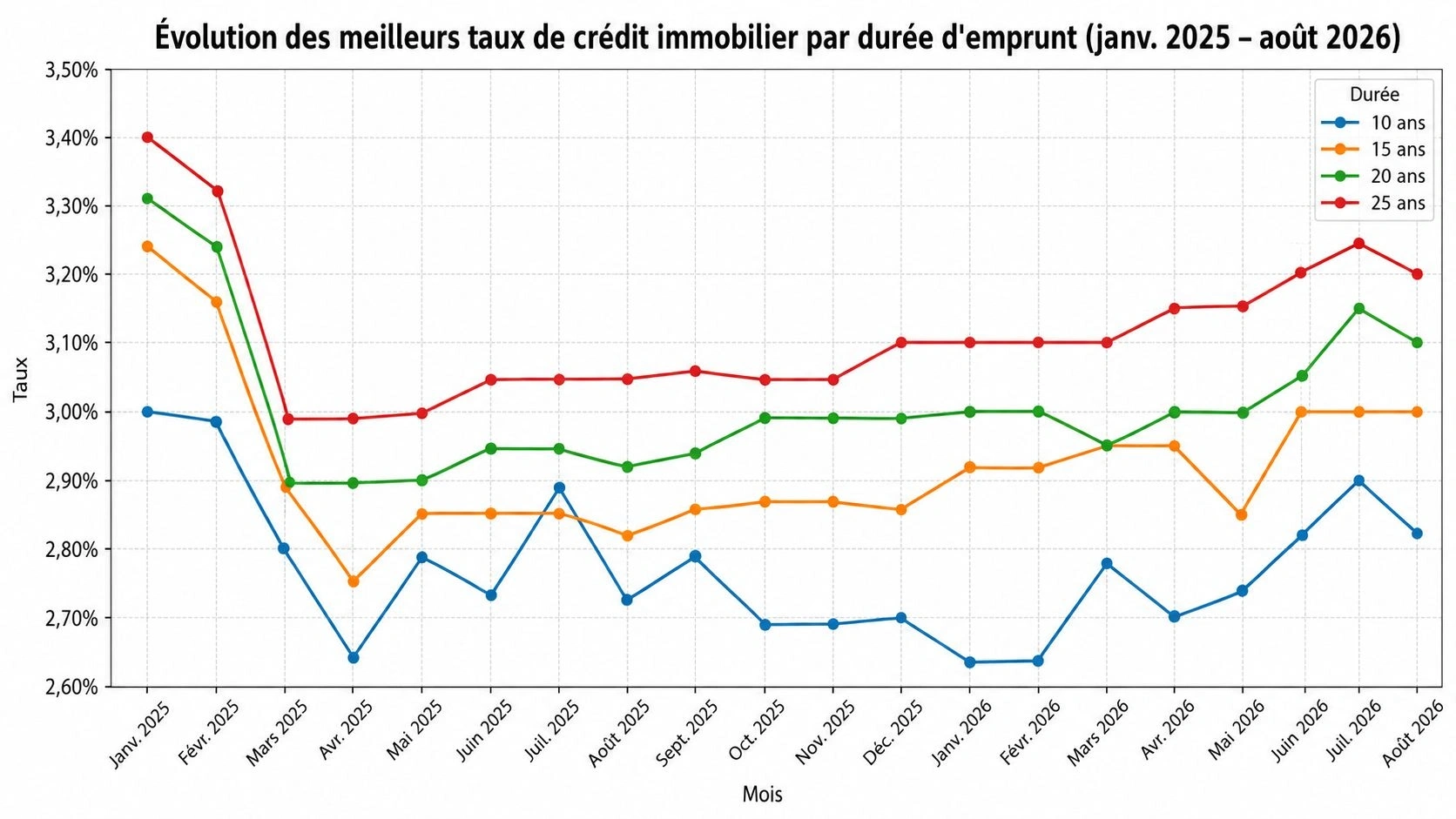
An evolution chart illustrates recent trends. It complements the main table and makes it easier to read the history of rates since January 2025.
Comparison table of mortgage borrowing rates: lowest, average and market rate scale
Term | Lowest rate August 2026 | Average rate August 2026 | Market rate scale August 2026 |
|---|---|---|---|
10 years | 2.82% | 3.02% | 3.48% |
15 years | 3.00% | 3.19% | 3.71% |
20 years | 3.10% | 3.31% | 3.84% |
25 years | 3.20% | 3.42% | 3.98% |
What do these figures mean? Definitions and vocabulary
Before comparing offers, it is useful to understand the essential concepts. The nominal rate is the percentage applied to the capital borrowed. The APR includes the nominal rate, borrower insurance and fees. The APR reflects the overall cost of credit and should remain your main comparison criterion.
Borrower insurance covers risks such as death, disability and sometimes job loss. It is expressed as a percentage of the capital and increases the APR. Application fees and guarantees, such as a mortgage or guarantee bond, are added to the total cost. Finally, early repayment charges may apply in the event of early repayment.
To compare two offers, always look at the APR. It includes external insurance if you choose a delegated insurance policy. A rate comparison tool or broker can help you assess both the rate and the insurance.
Nominal rate, APR and borrower insurance
The nominal rate determines the interest paid on the capital. The APR adds insurance and fees. In practice, insurance at 0.30% represents around €600 per year on a €200,000 loan.
Comparing APRs helps avoid surprises and identify potential savings through delegated insurance. Always ask for a quantified and itemised offer before signing.
Difference: lowest rate vs market rate scale
The lowest rate reflects the best negotiated conditions for excellent borrower profiles. The market rate scale corresponds to the rates displayed in catalogue offers. The 25-year market rate scale here is 3.98%, compared with a lowest rate of 3.20% over the same term.
Access to the best rate depends on lending criteria: personal contribution, income stability, low debt-to-income ratio and guarantees. Prepare a solid application to target the lowest rate, or negotiate the insurance to improve your offer.
Why rates change: macroeconomic factors
Mortgage rates follow several macroeconomic drivers. ECB monetary policy has a direct influence. Government bond yields, particularly the 10-year French OAT, serve as a benchmark. Inflation and the risk premium affect bank margins.
In 2026, the ECB, inflation trends and the economic outlook remain the key factors to watch. An increase in key interest rates makes bank refinancing more expensive. Banks then adjust their rate scales according to their commercial strategy. The slight easing observed in August reflects a market environment that is more favourable to borrowers.
Geopolitical uncertainty or a deterioration in sovereign risk can also push bond yields higher. An increase in the OAT yield often leads to higher bank mortgage rates in order to preserve profitability.
The role of the ECB and key interest rates
The European Central Bank sets key interest rates. A loosening of rates makes it easier for market rates to fall. Conversely, tightening pushes them higher.
Banks do not mechanically apply every movement. They take into account their refinancing costs and commercial appetite. Follow ECB announcements to anticipate trends.
Influence of bond markets, OAT yields and inflation
The 10-year French OAT serves as a long-term reference point. If its yield rises, banks often reprice their rate scales. The 20- and 25-year segments are particularly sensitive.
The risk premium, volatility and public deficit influence perceptions of sovereign risk. These factors determine the trajectory of bond yields and, consequently, mortgage rates.
Comparison and recent evolution of the best mortgage rates from January 2025 to August 2026
Month | 10 years | 15 years | 20 years | 25 years |
|---|---|---|---|---|
Jan. 2025 | 3.00% | 3.25% | 3.31% | 3.40% |
Feb. 2025 | 2.99% | 3.16% | 3.24% | 3.32% |
Mar. 2025 | 2.80% | 2.90% | 2.89% | 2.99% |
Apr. 2025 | 2.65% | 2.75% | 2.89% | 2.99% |
May 2025 | 2.79% | 2.85% | 2.90% | 3.00% |
Jun. 2025 | 2.74% | 2.85% | 2.95% | 3.05% |
Jul. 2025 | 2.90% | 2.85% | 2.95% | 3.05% |
Aug. 2025 | 2.73% | 2.81% | 2.92% | 3.05% |
Sep. 2025 | 2.79% | 2.85% | 2.94% | 3.06% |
Oct. 2025 | 2.69% | 2.86% | 2.99% | 3.05% |
Nov. 2025 | 2.69% | 2.86% | 2.99% | 3.05% |
Dec. 2025 | 2.70% | 2.85% | 2.99% | 3.10% |
Jan. 2026 | 2.64% | 2.92% | 3.00% | 3.10% |
Feb. 2026 | 2.64% | 2.92% | 3.00% | 3.10% |
Mar. 2026 | 2.78% | 2.95% | 2.95% | 3.10% |
Apr. 2026 | 2.70% | 2.95% | 3.00% | 3.15% |
May 2026 | 2.74% | 2.85% | 3.00% | 3.15% |
Jun. 2026 | 2.82% | 3.00% | 3.05% | 3.20% |
Jul. 2026 | 2.90% | 3.00% | 3.15% | 3.25% |
Aug. 2026 | 2.82% | 3.00% | 3.10% | 3.20% |
Over recent months, movements have been measured. After the slight increase observed in June and July, August 2026 marks a slight decline in the best rates, which return to levels close to those seen in the spring. We remain far from the sharp fluctuations of 2022–2023.
The six-month evolution shows differences of a few tenths of a point depending on the loan term. The one-year evolution remains moderate for most terms. Over three years, the initial rise followed by the adjustment remains visible in the data series.
These reference points come from the Observatoire Crédit Logement and the Banque de France. They help track mortgage credit production and the average duration of loans in 2026.
Monthly rate evolution chart
The chart below translates the evolution table: it illustrates the trajectory of the best rates for each term — 10, 15, 20 and 25 years — from January 2025 to August 2026.
One-year trends
Between August 2025 and August 2026, the net movement was almost stable, with rates remaining contained. The average 20-year rate at 3.31% illustrates this balance, now slightly more favourable than in July.
The reasons include the recent easing in bond yields and the more aggressive positioning of certain banks seeking to increase lending volumes. These factors explain the rate-scale adjustments observed.
Impact on the average loan term and credit production
To preserve monthly payments, banks sometimes encourage longer loan terms of 20 to 25 years. This reduces the monthly payment but increases the total cost of credit.
Mortgage credit production tends to recover when rates ease. Homebuyers adapt their strategy: personal contribution, loan term, or moving forward with a project that had been postponed.
Types of rates and which choice for your real estate project
The choice between a fixed rate, variable rate and mixed rate depends on the borrower profile and time horizon. A fixed rate offers the security of constant monthly payments. A variable rate may be suitable if you plan to sell quickly or if you expect rates to fall.
A mixed rate combines an initial fixed-rate period followed by a revisable period. It makes it possible to combine initial protection with the opportunity to benefit from a later fall in rates. Choose according to your risk tolerance and holding horizon.
Fixed, adjustable/variable and mixed rates: cost and borrower profiles
A fixed rate is often slightly higher than a variable rate, but it protects against a rise in rates. It is suitable for households seeking security.
An adjustable rate may be attractive for a quick resale or early repayment. A mixed rate appeals to borrowers who want initial protection and flexibility thereafter.
Advantages and risks by borrower profile
For a first-time buyer in August 2026, favour a fixed rate and an appropriate term, often 15 or 20 years. For a buy-to-let investor, prioritise cash flow and profitability.
Assess your repayment capacity, income stability and personal contribution. These factors determine the most relevant type of rate for your project.
Concrete impact on budget and borrowing capacity
Borrowing capacity depends directly on the rate. A decrease of a few tenths of a point improves purchasing power. It is essential to quantify this effect through a dedicated simulation.
The 35% debt-to-income ratio rule remains a key benchmark. For a given monthly payment ceiling, a lower rate increases the amount of capital that can be financed. Adjust the loan term or personal contribution to optimise your project.
The August 2026 mortgage loan simulation allows you to quickly estimate your room for manoeuvre and adjust your strategy.
Simple calculation: monthly payments and total cost
For €200,000 over 20 years, the simulation illustrates the effect of a difference in rate. Compare the monthly payment and the total cost of credit for different rates.
Consider insurance and fees to obtain the overall cost. These elements have a significant impact when comparing different loan terms and rates.
Scenarios: increase or decrease and effect on purchasing power
Indicative scenarios: a decrease of 0.2 to 0.3 percentage points improves borrowing capacity by a few thousand euros. An increase of 0.3 to 0.5 percentage points reduces purchasing power by 5% to 7%, depending on the loan term.
Possible actions: take advantage of the current easing to move forward with a project, increase your personal contribution, adjust the loan term or renegotiate if the gap becomes attractive.
Practical cases by sector: new-build, rental investment, prestige property, life annuity sales and commercial premises
Needs differ depending on the sector. Financing a new-build property off-plan or through the zero-interest loan follows specific rules. Financing commercial premises often requires a professional loan.
For a rental investment, performance depends on the rent, charges, taxation and monthly payment. Calculate gross and net rental yield while factoring in the cost of credit.
Prestige properties, life annuity sales and commercial premises require appropriate guarantees and support. Contact an adviser for these complex cases.
Loan for new-build property and zero-interest loan
The 2026 zero-interest loan remains a lever for first-time buyers in the new-build market. It reduces the amount to be borrowed and improves purchasing capacity. Check income ceilings and eligible zones before preparing your application.
Combining a zero-interest loan with a standard loan can make some projects feasible despite a still-high market rate scale.
Rental investment: cash flow and profitability
Example: purchase price €250,000, 20% personal contribution (€50,000), €200,000 loan over 20 years at the average rate of 3.31%, rent of €1,100, charges of €250 per month. The approximate monthly payment is around €1,146.
Gross cash flow = 1,100 − 1,146 = −€46/month. Net cash flow after charges = −€296/month. If the rent increases to €1,400, gross cash flow becomes +€254/month. These figures show the importance of rent and rate levels for project viability.
Prestige properties, life annuity sales and commercial property
Banks require strong proof of solvency for prestige properties. Life annuity sales require legal support. Loans for commercial premises are often granted based on turnover and the business plan.
Renegotiation, refinancing and alternative solutions
Renegotiation or refinancing can be worthwhile if the rate gap offsets the costs. Fees include early repayment charges, application fees and guarantee fees. A practical rule: a gap of 0.7 to 1 percentage point is often necessary for refinancing to be profitable, depending on the remaining term.
Delegated insurance can reduce the APR. Payment modulation or temporary suspension can help during a financial episode. Use a simulation to quantify the break-even point.
When to renegotiate or refinance your loan
Renegotiate if your profile has improved, if the rate gap is significant or if the remaining term is long. Compare potential savings and refinancing costs before making any decision.
Costs and benefits: quick calculation
Simple method: multiply the annual saving by the number of years remaining, then subtract early repayment charges and fees. If the result is positive, refinancing may be profitable. For an accurate calculation, use the Capifrance simulator.
Practical advice to obtain the best mortgage borrowing rate in August 2026
Checklist: build up a personal contribution, stabilise your income, reduce your debt-to-income ratio, compare offers and consider delegated insurance. Present a complete application to improve your chances.
A broker or local real estate adviser can play banks against each other and negotiate insurance. Take care with the presentation of the application: payslips, tax notices, bank statements and preliminary sale agreement.
Preparing your application: personal contribution, income, guarantee
Key documents: your last three payslips, tax notice, bank statements, proof of personal contribution and preliminary sale agreement if available. A personal contribution of 10% to 20% makes it easier to access the best rate scales.
Negotiation, broker and offer comparison
The broker negotiates conditions and finds exclusive offers. The Capifrance adviser adds local knowledge and property valuation expertise. Together, they optimise the financial structure.
Concrete example: mini quantified case study
Here are two simple scenarios to illustrate the impact of a good rate on your budget: a first-time buyer and a rental investor. These examples show the value of a personalised simulation.
Buyer scenario: €200,000 over 20 years
Assumptions: €200,000 borrowed over 20 years, excluding insurance for simplicity. With the average 20-year rate at 3.31%, the approximate monthly payment is around €1,146. With the lowest 20-year rate at 3.10%, the monthly payment is around €1,120.
Approximate monthly saving: €26, or around €312 per year and more than €6,200 over 20 years in interest, excluding insurance. These orders of magnitude show the value of negotiating the rate.
To include insurance, add a range of 0.30% to 0.50% depending on the borrower profile. Use the Capifrance simulator for an accurate estimate.
Rental investor scenario: profitability calculation
Assumption: purchase price €250,000, 20% personal contribution, €200,000 loan over 20 years at the average rate of 3.31%, rent of €1,100, charges of €250. Approximate monthly payment: €1,146.
Gross cash flow = 1,100 − 1,146 = −€46/month. Net after charges = −€296/month. If the rent reaches €1,400, gross cash flow becomes +€254/month. Adjust personal contribution and loan term to improve net profitability.
Legal and insurance points to watch
Check the loan offer and its 10-day reflection period. Make sure that the APR, duration and repayment terms are clearly stated. For legal matters, consult Legifrance.
Mortgage insurance, delegated insurance and contractual clauses require careful reading. Early repayment charges and application fees can reduce the benefit of refinancing if poorly assessed.
If in doubt, ask a specialist or local real estate adviser to secure your financial structure.
Borrower insurance: options and costs
Common guarantees: death, total permanent disability and temporary incapacity for work. The cost varies depending on age, health status and insured share. Rates range from 0.20% to more than 1% of the capital depending on the profile.
Delegated insurance often offers substantial savings if the guarantees are equivalent. Compare offers carefully before making your choice.
Mobility clauses, payment modulation and penalties
Check the monthly payment modulation clauses, the possibility of payment pauses and the conditions for early repayment charges. These options add flexibility but may come with strict conditions.
Negotiate these elements if you anticipate a job relocation, variable income or a future resale.
How to adapt your strategy according to your project
The strategy depends on the borrower profile. For a first-time buyer, prioritise security with a fixed rate and a 15- to 20-year term. For an investor, prioritise profitability and cash flow.
For a quick resale, an adjustable or mixed rate may be considered. Discuss the choice of loan term and personal contribution with your local adviser.
First-time buyer vs investor vs quick resale
Summary: security = fixed rate over 15/20 years; investor = priority to profitability; quick resale = consideration of an adjustable or mixed rate. Adapt the strategy to your time horizon.
Choosing the term and balancing monthly payment against total cost
Practical rule: set a monthly payment ceiling while respecting the 35% debt-to-income ratio. Choose the term that preserves this ceiling while limiting the total cost of credit.
Compare 15-, 20- and 25-year simulations to measure the impact on the monthly payment and overall cost before committing.
The role of a local real estate adviser
A local Capifrance real estate adviser provides proximity-based expertise. They offer to estimate the value of your property, advise you on pricing strategy, put you in touch with brokers and banks, and help you optimise the financial structure.
The adviser supports you from the initial diagnosis through to signing. They offer a free assessment of your real estate project and facilitate introductions to suitable partners.
For tailored support, contacting a Capifrance adviser is the most effective step to secure your transaction.
Conclusion
- Mortgage rates in August 2026 confirm a slight easing in the best rates and average rates, while the market rate scale remains stable.
- Key points: average 20-year rate at 3.31%; lowest 20-year rate at 3.10%; 20-year market rate scale at 3.84%.
- To optimise your borrowing capacity in August 2026, adjust the loan term and personal contribution, and systematically compare the APR.
- Contact a Capifrance adviser for a personalised analysis, local support with your real estate projects and a possible introduction to a broker to obtain the best borrowing conditions.
- The rates presented are indicative; consult your bank or adviser for a personalised offer.
FAQ
What is the average 20-year rate in August 2026?
The average 20-year rate in August 2026 is 3.31%. See the table above for details by term and rate category.
Did rates fall between July and August 2026?
Yes, slightly. The best rates and average rates fell by a few hundredths of a point — the lowest 20-year rate moved from 3.15% to 3.10% — while the catalogue rate scale remained stable.
Can I renegotiate my loan if rates fall?
Yes, but you need to calculate the net profitability. Compare the interest savings with renegotiation costs, early repayment charges and fees.
Which term should I choose today: 15, 20 or 25 years?
The choice depends on the objective: 15 years reduces the total cost, 20 years balances monthly payment and cost, while 25 years lowers the monthly payment but increases the total cost.
How does borrower insurance affect the APR?
Insurance is added to the nominal rate and increases the APR, which remains the best criterion for comparing overall offers.
Should I wait to buy or move forward now?
There is no universal answer. The easing seen in August is favourable, but assess your long-term project, your borrowing capacity and consult a local adviser to choose the best timing.
Author :

Frédéric Rémy – Director of Commercial Performance
A real estate professional for several years within the Capifrance network, I would like to share with you some essential advice to help you succeed in your real estate project with the support of our advisors.