








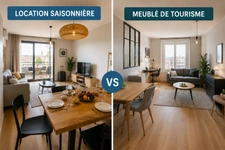
Is seasonal rental investment really more profitable than long-term letting? What steps should you take, what taxation should you plan for, and which costs should you build into your budget? This 2026 guide answers these questions point by point: it breaks down how seasonal rentals work, how they are managed and how they are taxed, and it offers a fully costed worked example to move from theory to hard numbers. Updated on 01/06/2026.
Contact a local Capifrance advisor for a free assessment.
In brief
The essentials to keep in mind before you get started:
- Market and opportunity:seasonal rentals retain superior rental yield potential, which varies sharply depending on the micro-market and the season.
- Legal and tax obligations 2026: register your activity, keep track of the reform introduced by the Le Meur Act, and check the local registration with the town hall requirements (Service-Public).
- What makes a property perform: a strategic location, a studio / one-bedroom layout, accessibility, and co-ownership rules compatible with short-term letting.
- Management and support:dynamic pricing, the use of local rental management or a concierge service, and the support of a real estate advisor to optimize profitability.
Contact a Capifrance advisor for a precise estimate of profitability in your municipality.
Understanding seasonal rental investment in 2026
A seasonal furnished rental means making a furnished home available to a transient clientele for short stays. The Tourism Code (article L.324-1-1) defines a tourist furnished rental as a home let to a clientele that does not take up residence there. An official classification, where obtained, boosts commercial visibility and can push the ADR (average daily rate) higher.
Compared with year-round letting, short-term rental often generates a better yield per square meter. In return, it demands far more active management: check-in, cleaning, maintenance, and constant rate adjustments. The investor pursues three goals: cash flow, asset appreciation, and control of seasonality, which they steer using regularly monitored KPIs.
The context has shifted. Since 2024, the Le Meur Act and the 2025 Finance Act have reshuffled the deck on taxation and registration, changing certain ceilings and allowances that apply to furnished rentals, whether classified or not. At the same time, the formalization of local declarations is tightening, and it differs from one municipality to the next.
On the numbers, national occupancy rates generally range between 50% and 70% depending on the destination. Tight markets show rising ADR and RevPAR figures in recent years. For reliable data, rely on AirDNA, INSEE, and tourism observatories.
Before investing, conduct a local market study using AirDNA and an analysis of competing listings. Then ask a Capifrance advisor for a local assessment to obtain a personalized projection.
What is a seasonal rental, or tourist furnished rental?
A tourist furnished rental is an equipped home designed for a transient clientele. It can be classified or unclassified. For a primary residence, some municipalities cap letting at 120 days per year. Two things set this activity apart from long-term letting: its temporary nature and the rapid turnover of occupants.
The tourist furnished rental classification acts as a quality label. It reassures travelers and allows for a higher ADR. Before committing, however, check its tax and administrative impact in your municipality.
Why choose seasonal rental investment?
The advantages are clear: a potentially higher gross yield and faster appreciation in attractive areas. The flexibility of use also lets you alternate between letting and personal occupancy. Conversely, the drawbacks lie in intensive management and the seasonality of income.
These constraints can be managed with method. Carefully select your micro-market, optimize the property, and adopt dynamic pricing. And don't hesitate to outsource some tasks to a concierge service or to professional rental management.
Trends and figures for 2026: demand, seasonality, occupancy rate
Three indicators sum up a property's performance: the ADR, the RevPAR, and the occupancy rate. They allow you to benchmark against local and national averages. On the French Riviera, in mountain resorts, and in major cities, ADR and occupancy rates have risen.
Secondary markets, on the other hand, show marked gaps between high and low season. For reliable benchmarking, cross-reference AirDNA, local observatories, and Airbnb/Booking listings. Above all, build in a 20% safety margin to absorb the unexpected and quiet periods.
Choosing a high-potential property for seasonal letting
The choice of property alone determines the success of your seasonal rental investment. Favor an attractive location and a sought-after layout, and never skip three steps: market study, on-site visit, and financial simulation before buying.
Next, check the co-ownership rules and, if needed, the feasibility of a change of use. Look for proximity to transport, beaches, train stations, or business districts depending on your target. A parking space or a bike storage room often boosts appeal.
Finally, aim for a good price-to-volume ratio and a floor area suited to local demand. Areas of 30 to 60 m² are generally well suited to studios, one-bedroom and two-bedroom units. Contact a Capifrance advisor for a precise local estimate.
Location and micro-market: which areas to prioritize?
The micro-market is the immediate neighborhood and its points of interest. Depending on your target clientele, prioritize proximity to a beach, a train station, a historic center, or a business park. And analyze the competition at the neighborhood level, not just the city.
Also keep local rules in mind: quotas, the 120-day cap for a primary residence, and change of use. Reach out to the town hall or Service-Public to learn the rules in force.
Optimal layouts and floor areas: studio, one-bedroom, two-bedroom
Studios, one-bedroom and two-bedroom units often deliver the best yield per square meter. They appeal to a broad clientele while limiting the initial purchase cost. As a rough guide: 25 to 35 m² for a studio, 35 to 55 m² for a two-bedroom unit in a touristy urban area.
A three-bedroom unit can make sense for a family clientele or in a holiday-resort area. As for prestige villas, they call for premium management but can deliver a high-end yield.
Local market study and analysis tools: AirDNA, demand estimation
Use AirDNA to obtain ADR, occupancy rate, and RevPAR data. Round it out with Airbnb/Booking listings and local observatories. By comparing the amenities and advertised prices, you can estimate the area's real demand.
Then build a profitability simulation that includes average rates, projected occupancy, and all costs. Here too, a 20% safety margin strengthens the robustness of your business plan.
A worked example: a profitable studio
Let's take concrete assumptions: a purchase price of €150,000, acquisition costs of 8% (€12,000), and €15,000 of renovation work. On the operating side, an ADR of €90 per night, a 60% occupancy rate, a 15% platform commission, and a concierge service at 20%.
Item | Amount (€) |
|---|---|
Purchase price | 150,000 |
Acquisition costs (8%) | 12,000 |
Renovation work | 15,000 |
Total invested | 177,000 |
ADR (€/night) | 90 |
Annual occupancy rate | 60% |
Gross annual income (90 × 365 × 0.6) | 19,710 |
Platform commission (15%) | 2,956.50 |
Concierge fees (20%) | 3,942 |
Annual cleaning (55 stays × €30) | 1,650 |
Property tax (est.) | 800 |
Co-ownership charges | 1,500 |
Insurance and maintenance | 1,200 |
Total annual costs | 12,048.50 |
Net income before tax | 7,661.50 |
Gross yield (gross income / purchase price) | 13.14% |
Net yield (net income / purchase price) | 5.11% |
Real net yield (net income / total invested) | 4.33% |
This worked example illustrates an essential truth: everything hinges on accounting for the costs. Results vary sharply depending on location and the quality of management. The right reflex is to test several scenarios of occupancy and ADR to gauge how sensitive your project is.
Renovation, fittings, and equipment to maximize income
Renovation work and furnishings have a direct impact on the ADR and the occupancy rate. Focus your efforts on high-return interventions: a modern bathroom, quality bedding, a fitted kitchen, and high-speed Wi-Fi. Add to that professional photos and tasteful décor, which push up the conversion rate.
Indicative budget: count on €5,000 to €10,000 for a light refresh, €20,000 to €40,000 for a full renovation depending on the floor area. Calibrate the envelope according to the initial condition and the positioning you're after, standard or prestige.
On the equipment side, the must-haves are: Wi-Fi, high-performance air conditioning or heating, a washing machine, a TV, a fitted kitchen, and comfortable bedding. A parking space, or a local arrangement to park, remains a real plus. Finally, paid services (breakfast, bike hire, concierge) can raise the nightly rate by 10 to 20%.
Priority works and renovation budget
Start with compliance and safety: electrics, detectors, ventilation. Then improve comfort: bedding, bathroom, insulation. Finally, aesthetics and finishes feed customer reviews and support the booking rate.
Essential equipment and value-added services
First, put together a minimum list: high-speed Wi-Fi, quality bedding, a fitted kitchen, and baby equipment on request. Add value-added services: professional cleaning, a local concierge, breakfast options. All of these enrich the customer experience and allow for more ambitious pricing.
Classification and quality: the tourist furnished rental classification
The tourist furnished rental classification is optional, but it provides visibility and trust. The process involves an audit and a certain cost: before you commit, estimate the potential gain on the ADR to make sure it's worth it.
Setting the rental price and calculating profitability
Setting the price rests on three levers: the ADR, the expected occupancy rate, and seasonality. Dynamic pricing, steered via a channel manager, lets you adjust rates in real time. And monitoring your KPIs (ADR, RevPAR, gross and net yield) remains essential to managing performance.
A few concrete rules: set a floor price, require minimum stays in high season, and offer discounts off-season. Also remember to adjust your rates during local events, which give demand a temporary boost.
How to set your price: ADR, high season, pricing strategy
The ADR is the average price per night. The RevPAR, in turn, is calculated by multiplying the ADR by the occupancy rate. In practice, review your rates at least once a week in high season, and every two weeks off-season.
Practical calculations: gross yield, net yield, cash flow, RevPAR
Keep these simple formulas in mind: gross yield = annual income / purchase price; RevPAR = ADR × occupancy rate; net yield = (income − costs) / purchase price. Applied to the worked example above, they give you realistic ranges.
Costs to plan for: charges, concierge, taxation
Forget no item: property tax, co-ownership charges, insurance, concierge fees (15 to 25%), and professional cleaning. Add to that platform commissions (10 to 20%), maintenance, and furniture depreciation. And build up a reserve of about 20% for the unexpected and quiet periods.
Regulation and taxation of seasonal rentals in 2026
The regulatory and tax framework has seen recent changes. First rule: register your activity with the town hall and obtain a registration number if the municipality requires one. For a second home, a change of use may be necessary.
Three main tax regimes are available to you: the micro-BIC, the LMNP (non-professional furnished landlord), and the actual-expenses regime (régime réel). The micro-BIC applies a flat-rate allowance; the actual-expenses regime allows you to deduct costs and depreciate the property.
The Le Meur Act and the 2025 Finance Act have changed certain thresholds. When you file, check the applicable ceilings and allowance, and have your choice validated by an accountant.
Finally, schemes such as the Censi-Bouvard or VAT recovery exist for new builds in serviced residences. Depreciation under the LMNP regime can also reduce the taxable base. The value of these schemes, however, depends on your project and its contractual commitments.
Legal note. This article is informational. Tax and local rules change fast: for tailored advice, consult an accountant, a lawyer, or your local Capifrance advisor. Information valid as of the publication date.
Local declarations and rules of use: town hall registration, 120 days
The first formality is the seasonal rental declaration with the town hall. Obtain the registration number if your municipality requires it. Some cities cap the letting of a primary residence at 120 days per year.
For a second home, a change-of-use authorization may be mandatory, and penalties apply in the event of non-compliance. The reflex to adopt: always check with the town hall.
Tax regimes: LMNP, micro-BIC, actual-expenses regime, 2024-2026 changes
The micro-BIC applies automatically below a revenue ceiling and grants a flat-rate allowance. The actual-expenses regime, on the other hand, lets you deduct costs and depreciate the property. The LMNP status suits non-professional landlords and makes this depreciation easier.
The reform driven by the Le Meur Act and the 2025 Finance Act changes the rules for certain landlords. When you file, check the thresholds and allowances in force, and have your structure validated by a professional.
Schemes and optimizations: Censi-Bouvard, depreciation, VAT recovery
The Censi-Bouvard scheme applies, under conditions, to serviced residences. VAT recovery is possible for certain new-build programs. And under the LMNP actual-expenses regime, depreciation of the property and furniture reduces the taxable base.
Taxes and obligations: tourist tax, VAT, capital gains tax
You must collect and remit the tourist tax in line with local rules. VAT applies only exceptionally to tourist furnished rentals, save in special cases. As for the capital gains tax on resale, it is taxable, with possible exemptions depending on the length of ownership.
Managing and marketing your seasonal rental
Marketing rests on a trio: visibility, listing optimization, and operational management. Distribute your offer across several channels — Airbnb, Booking, a direct website — and synchronize calendars and rates using a channel manager.
An optimized listing (title, experience-focused description, professional photos) mechanically increases bookings. Review management and service quality, for their part, build your reputation. What remains is to choose the management model suited to your availability and the size of your portfolio.
Self-management or concierge: choices and costs
Self-management cuts costs, but it requires time and skills. A local concierge generally costs 15 to 25% of income, in exchange for genuine responsiveness and quality of welcome. If you manage from a distance or own several properties, outsourcing often becomes the obvious choice.
Platforms and tools: Airbnb, Booking, channel manager, dynamic pricing
Adopt a multichannel strategy and synchronize everything via a channel manager. Rely on AirDNA for benchmarking, and on revenue management tools to fine-tune your dynamic pricing.
Customer experience: professional photos, description, reviews
Invest in professional photos and a clear welcome booklet. Write a benefits-focused description that speaks to the experience more than the square footage. And respond quickly to reviews, correcting the points that come up repeatedly.
Operational management: check-in, cleaning, maintenance, co-ownership
Put procedures in place for check-in, the inventory of fixtures, and check-out. Contract out professional cleaning and preventive maintenance. Finally, comply with the co-ownership rules and keep the building manager (syndic) informed to avoid any conflict.
Financing, insurance, and legal aspects
The financing structure is built around the mortgage, the down payment, and borrowing capacity. Prepare a solid file, backed by a cash-flow simulation and a local market study. Long-term loans increase leverage while easing the monthly burden.
On the coverage side, non-occupant landlord insurance and a suitable multi-risk policy are indispensable. Note that the rent-default guarantee (GLI) is generally unsuited to seasonal letting. Discuss possible extensions with your insurer.
Financing structure and mortgage
Set the right parameters: down payment, term, interest rate. Factor your rental income into your borrowing capacity, within the limits set by the bank. And present a clear business plan: it's your best argument for negotiating a good rate.
Essential insurance and guarantees
Make sure you have a multi-risk insurance policy and public liability coverage. Above all, check their compatibility with short-term letting, and consider additional guarantees depending on the level of risk.
Lease, rental status, types of contract, and duration
Seasonal letting relies on seasonal contracts or suitably adapted general terms. The mobility lease is an alternative for certain specific situations. In every case, provide clear clauses on cancellation and damage.
Legal risks: compliance, penalties, nuisance in co-ownership
The main risks? Fines for non-declaration, withdrawal of authorization, conflicts within the co-ownership. The remedy comes down to two words: compliance and town hall registration. In the event of a dispute, call on a legal advisor.
Special cases: new builds, prestige, life annuity, commercial premises
Each property type calls for a specific approach. New builds sometimes open the door to VAT recovery and tax schemes. The prestige segment requires premium management and tailored insurance.
The life annuity (viager), for its part, often complicates tourist operation because of usage rights. As for conversions into commercial premises or tourist residences, they involve VAT rules and specific authorizations. Each of these cases warrants analysis by a local advisor and a tax expert.
Investing in new builds: schemes
A new build in a serviced residence can give access to the Censi-Bouvard scheme and to VAT recovery. Be mindful, however, of the rental commitments and the quality of the operator.
Prestige properties: villas, market, management
Villas command a high nightly rate, but require targeted marketing. Premium concierge service, security, and upkeep are major cost items here.
Life annuity: mixed strategies
The life annuity (viager) brings usufruct and bare ownership into play. These structures require in-depth legal and tax advice before any operation.
Rentals tied to a commercial activity and services
Tourist residences and commercial conversions often fall under specific VAT rules. They require authorizations and a suitable tax structure.
Best practices, KPIs, and pitfalls to avoid
Steer your project with a simple dashboard. Apply concrete best practices and anticipate risks. Track the KPIs that matter: occupancy rate, ADR, RevPAR, net yield, and cash flow.
Conversely, steer clear of the three classic mistakes: non-declaration, underestimating costs, and failing to comply with the co-ownership rules. And keep a financial reserve of at least 20% to secure the whole thing.
10 best practices to maximize profitability
- Conduct a local market study before buying.
- Prioritize the location and the micro-market.
- Optimize the listing (professional photos, listing SEO).
- Set up dynamic pricing via a channel manager.
- Select the essential equipment (Wi-Fi, air conditioning, bedding).
- Entrust the cleaning to professionals.
- Outsource management if you are remote.
- Track your KPIs every month and adjust the strategy.
- Plan a financial safety margin (20%).
- Comply with local obligations (town hall registration).
Common pitfalls and how to avoid them
Avoid non-declaration and budget your costs as accurately as possible. Check the co-ownership rules before buying. Anticipate maintenance and secure suitable insurance.
Dashboard: indicators to track
KPI | Formula | Frequency | Target |
|---|---|---|---|
Occupancy rate | Nights booked / nights available | Monthly | Varies by market |
ADR | Income / nights booked | Monthly | Optimize by segment |
RevPAR | ADR × occupancy rate | Monthly | Benchmark against the market |
Net yield | (Income − Costs) / purchase price | Annual | 5%+ depending on target |
Cost per booking | Total costs / number of bookings | Monthly | Reduce through optimization |
Why work with a local Capifrance real estate advisor
A local Capifrance real estate advisor brings you a precise market assessment and a realistic rent estimate. They support you on the financing structure, administrative compliance, and the selection of local tradespeople and concierge services. Their fine knowledge of the micro-market helps you optimize the location, the layout, and the pricing strategy.
Testimonial. "Ms. Dupont, a property owner in Nice, entrusted Capifrance with the estimate, the renovation, and the seasonal letting. The result: a 25% increase in the occupancy rate in the very first year."
Get a free local assessment with a Capifrance advisor for your project.
Conclusion
- Choosing the location and layout suited to the micro-market is the first key to success.
- Simulating profitability while accounting for all costs is essential.
- Optimizing the property through targeted works, careful furnishing, and professional photos improves the ADR and occupancy.
- Complying with local obligations and taxation protects your project.
- Steering through KPIs and adjusting dynamic pricing regularly.
- Outsourcing management to a local concierge is often wise for remote investors.
To secure and succeed in your project, contact a local Capifrance advisor: they will support you on the assessment, the financing structure, compliance, and management.
FAQ
What administrative steps are needed to launch a seasonal rental?
First and foremost, complete the town hall registration and, where applicable, request a change-of-use authorization for a second home. The rules (such as the 120-day cap) vary by municipality: reach out to the town hall or a local advisor.
What yield can you expect from a seasonal rental investment?
It all depends on location, layout, and management. Ranges of 4% to 8% gross are generally observed for well-managed properties, with variations depending on seasonality and the level of costs.
Which tax regime should you choose for a seasonal rental in 2026?
The choice depends on your revenue and costs: the micro-BIC is simple when revenue is modest, whereas the actual-expenses regime lets you depreciate the property and deduct costs. The LMNP status is common for non-professional landlords. Consult an accountant.
How do you manage a seasonal rental remotely?
The simplest solution is to outsource to a local concierge (check-in, cleaning, maintenance) or to entrust management to an agent. This represents 15 to 25% of income in general, but it secures operations over the long term.
What insurance and guarantees secure a short-term rental property?
The must-haves: non-occupant landlord insurance and a multi-risk policy suited to seasonal letting. The rent-default guarantee mainly targets long-term lets; for seasonal rentals, check the possible extensions with your insurer.
Author :

Frédéric Rémy – Director of Commercial Performance
A real estate professional for several years within the Capifrance network, I would like to share with you some essential advice to help you succeed in your real estate project with the support of our advisors.