







You should sell your property in 2027 if your life plans require it (job relocation, a growing family, separation, retirement), if the property costs you more than it earns you, or if a regulatory constraint is approaching, such as the ban on renting out homes rated F on 1 January 2028. Conversely, waiting for prices to rise in order to sell for more is a risky bet: prices are broadly stable to slightly downward, credit rates are rising and buyers negotiate almost systematically. The right decision should therefore be based on your personal situation and a recent valuation, not on a national forecast.
In summary
- The market at the end of 2026 is stable but selective: prices for existing homes are slightly down (-0.8% over one year in the second quarter according to notaries and Insee), average rates are around 3.5% over 20 years, and around 9 out of 10 sales are negotiated.
- Selling in 2027 makes sense if you need to buy elsewhere, if your property is energy-intensive, if it is vacant or if your costs are rising.
- Waiting is only worthwhile if you have no time constraints and your property is not exposed to a price discount (energy performance diagnostic, co-ownership works, a declining neighbourhood).
- The starting point remains a valuation at local market price, carried out by an advisor who knows the recent sales in your area.
The property market heading into 2027: what you need to know before deciding
Before choosing when to sell, you need to look at the three indicators that determine the price you will get: the level of prices, buyers' purchasing power and the balance between supply and demand.
Prices stable to slightly downward
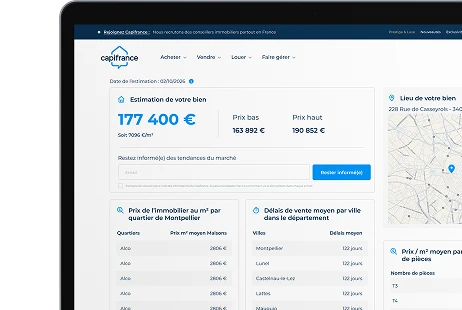
According to the Notaires-Insee indices, prices of existing homes fell by 1% in the second quarter of 2026, or -0.8% over one year, with -1.3% for houses and -0.1% for apartments. The notaries' projections for the end of November 2026 point to near stability. There is therefore neither a crash nor a rebound: this is a market that is adjusting slowly. To find out how your own property sits within this trend, a free property valuation is the best starting point.
Buyers with tighter budgets
The 10-year OAT, the rate at which the French State borrows, crossed 5% on 21 October 2026, for the first time since 2002, and the European Central Bank raised its key interest rates on 10 September (deposit rate at 2.50%, see the ECB's official press release). As a result, the average 20-year rate reaches 3.51% in November 2026 and several brokers expect it to move towards 4% in early 2027. Each increase reduces the amount your buyers can borrow.
More properties for sale than buyers in a hurry
The supply of properties is growing (+4% over one year according to Bien'ici, +9% according to Laforêt) while enquiries on listings are falling. The average time to sell is close to 100 days and the average negotiation margin reaches 4.8% nationally. A well-priced property sells; an overpriced one stalls.
The 6 questions to ask yourself to know whether to sell in 2027
1. Does your life plan require a specific date?
Job relocation, a birth, children leaving home, separation, retirement: when a change of home is certain, your personal timetable takes precedence over the market's timetable. Postponing a necessary sale often costs more (double housing costs, bridging loan, stress) than a few points of price.
2. Are you selling in order to buy again in the same market?
If you are selling in order to buy locally, the level of prices matters less than the gap between the two properties: if prices fall, you sell for less but you also buy for less. The real issue becomes financing the purchase, hence the value of locking in a rate while conditions remain acceptable.
3. Is your property exposed to a price discount?
A home rated F or G, a property that needs a new roof, or a co-ownership building about to vote on major works all suffer from a growing price discount. Properties rated F or G are regularly negotiated with a discount of more than 10%. For a landlord, the ban on signing a new lease for an F-rated home from 2028 (see the official page on the DPE on Service-Public.fr) reduces the number of interested investors.
4. How much does it cost you to keep the property?
Property tax (the tax bases of which are expected to rise by around 3% or more in 2027 with inflation), co-ownership charges, insurance, maintenance, outstanding mortgage, possible vacancy: add up these costs over 12 months. If waiting a year costs you €6,000 in the hope of gaining 2% on a €250,000 property, the trade-off is neutral at best.
5. What is your tax situation?
A main residence is exempt from capital gains tax. For a second home or a rental property, the length of ownership matters: exemption from income tax applies after 22 years and exemption from social contributions after 30 years. Selling a few months later can sometimes significantly reduce the bill.
6. Is your micro-market rising or falling?
National averages hide sharp differences: Brest shows +5.8% over one year, Nice +4.9% for apartments, while Nantes is down 3.1%. Only an analysis of recent sales on your street and in your neighborhood can tell you whether time is on your side. Browsing the property listings in your area also helps you gauge the competition your property will face.
Decision table: sell in 2027 or wait?
Your situation | Trend | Why |
|---|---|---|
Planned life change in 2027 | Sell | Avoid double costs and a bridging loan |
Home rated F or G | Sell or renovate quickly | Growing discount and rental bans |
Vacant or low-yield rental property | Sell | Holding costs eat into the value |
Second home owned for 20 years | Look into the tax treatment | The exemption at 22 years may change the calculation |
No plans, property in good condition, sought-after neighborhood | Waiting is possible | No constraint, little risk of a discount |
Need for cash for another project | Sell | The market does not promise a rapid rise |
Waiting for prices to recover: a bet to assess with caution
What could support prices
New-build housing production remains weak, which sustains demand for existing homes. A 2027 budget deemed credible by the markets could ease rates from mid-2027 and revive transaction volumes.
What could hold them back
An OAT yield staying durably above 5%, average rates close to 4%, and wait-and-see behavior linked to the 2027 presidential election could, on the contrary, prolong the adjustment phase. In this scenario, waiting would mean selling later and not necessarily at a higher price.
Selling in 2027: how to prepare your project in practice
Once the decision is made, the success of a sale in 2027 will depend above all on the quality of the preparation. In a market where buyers compare a lot and negotiate almost systematically, every detail counts.
Three to six months before listing
Have your property valued by a professional who knows your area, gather the documents (title deed, invoices for works, property tax, minutes of general meetings if you are in a co-ownership building) and check the validity of your DPE. If your home is heated by electricity, see whether the new DPE calculation on January 1, 2027 could improve its rating: it is an additional selling point, obtained without any works. To get support from this stage onward, find a real estate advisor near you.
One to two months before
Carry out the small jobs that reassure buyers (painting, visible repairs, garden upkeep), declutter the rooms and have the mandatory diagnostics carried out. Prepare your financing plan for what comes next: repayment of your outstanding mortgage, any early repayment penalties, and the budget for your next home.
On the day the listing goes live
Bright photos, a precise description and a price in line with recent sales make the difference in the very first week, the most important one for reaching active buyers. A property that stays on the market for several months loses appeal and often ends up being negotiated down further.
Selling and buying: coordinating the two transactions
If you are buying a new home, you have two options: sell first, which secures your budget but may require temporary accommodation, or buy first with a bridging loan (crédit relais), which is more comfortable but more expensive when interest rates rise. With an average rate of 3.51% over 20 years in November 2026, the bridging loan must be calculated precisely and backed by a prudent valuation of your current property.
The expert's view
"Every week, I meet owners who hesitate to sell because they are hoping for a better market next year. I always ask them the same questions: can your life plans wait? How much does another year with this property cost you? Is your home at risk of losing value because of its DPE (energy performance diagnostic) rating or upcoming renovation work? In the vast majority of cases, the answer shows that personal timing matters far more than market conditions. The 2027 market will be neither a seller's market nor a bargain-basement market: it will be a market for well-valued properties. Those that go on the market at the right price sell within a few weeks; those that test the market with an overly ambitious price end up negotiating harder, later. My advice: have your property valued now, even if you will not sell until spring, so that you can decide with figures rather than hunches."
— Frédéric Rémy, Commercial Performance Director at Capifrance
Conclusion
Deciding whether to sell in 2027 comes down to answering a simple question: will the market offer you more tomorrow than waiting costs you? In a context of stable prices, rising interest rates and demanding buyers, the answer is often no for energy-inefficient properties, properties that are costly to hold, or those tied to a life project. A recent valuation and a conversation with a local advisor remain the best basis for deciding.
A Capifrance advisor analyses recent sales in your area, tells you the realistic market price and helps you choose the right time. Start with a free property valuation, compare your property with the listings of properties for sale in your city, then find a real estate advisor near you. Do you have a friend or relative who is also hesitating about selling? You can refer them by becoming a Capifrance business referrer.
FAQ - Frequently asked questions
Will property prices fall in 2027?
Most professionals expect national prices to remain stable with local adjustments, and a slight decline for houses and energy-inefficient properties. No serious source is predicting a crash or a sharp rise.
What is the best month to sell in 2027?
Spring (March to June) attracts the most buyers. Preparing the sale from January (diagnostics, valuation, photos) allows you to be on the market at the right time.
Should you sell before buying?
Selling first secures your budget and avoids the bridging loan, which is more expensive when interest rates rise. Buying first is only advisable if your property is easy to sell and correctly valued.
My property is rated F: should I sell in 2027?
If it is a rental property with no renovation plans, selling before 2028 avoids losing the ability to re-let it. If it is your main residence, compare the cost of renovation work with the expected discount in value before deciding.
How long does it take to sell a property in 2027?
Allow an average of three to four months to find a buyer, then about three months between the preliminary sales agreement (compromis de vente) and the final deed of sale (acte authentique) at the notary's office.
Will the 2027 presidential election affect the sale?
Election years are often accompanied by a certain wait-and-see attitude, especially in terms of the number of sales. A well-valued property nevertheless remains sellable throughout the year.
Can you sell your property and remain a tenant in it?
Yes, some sales provide for the seller to remain in the property as a tenant, for example as part of the buyer's rental investment. This arrangement must be governed by a lease and planned for from the negotiation stage.
Author
Frédéric Rémy – Director of Sales Performance

A real estate professional with several years of experience within the Capifrance network, I would like to share essential advice with you to help you successfully complete your property project with our advisors.