









How much does a mortgage over 10, 15, 20, or 25 years cost today in France? This article presents mortgage rates in October 2026, their recent evolution, and the factors behind them. It also provides three forecast scenarios for the coming months, as well as advice for buyers and property sellers. For a personalized analysis of your project, Capifrance real estate advisors can assist you throughout France and connect you with partner mortgage brokers to negotiate the best borrowing terms.
Information updated in October 2026.
Summary
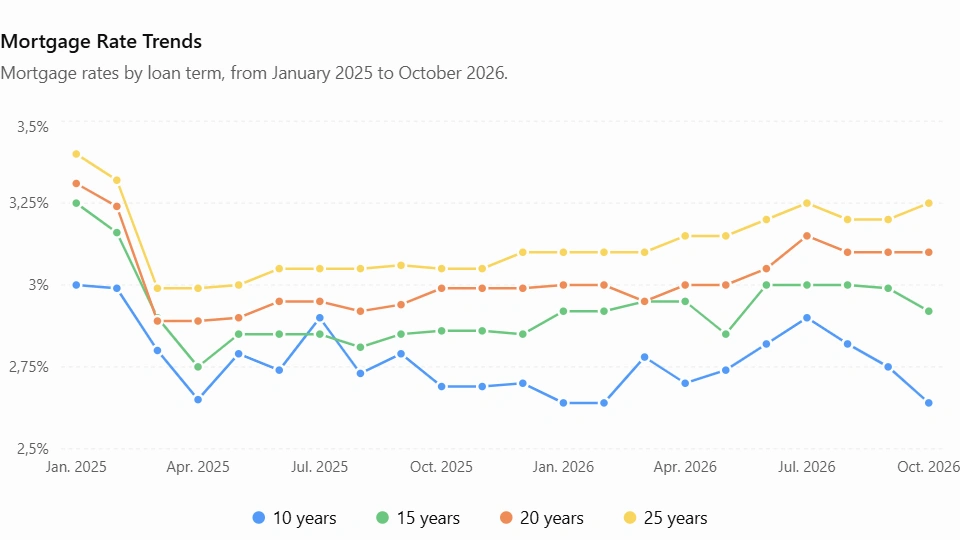
- October 2026 rates. The lowest rates range from 2.64% (10 years) to 3.25% (25 years), average rates from 3.08% to 3.53%, while standard market rates have remained stable for several months, ranging from 3.48% to 3.98% depending on the loan term.
- The trend. The best rates are easing slightly for shorter loan terms, while average rates continue to rise for longer terms, extending the trend observed since spring.
- Factors to monitor. ECB monetary policy, persistent pressure on the French 10-year OAT, France's national budget outlook for 2027, inflation trends, and the impact of the 2026 PTZ on first-time buyers' purchasing capacity.
- Our recommendation. Serious buyers would benefit from moving forward without waiting for a hypothetical drop in rates, while property sellers can proceed with confidence, ideally with the support of a local Capifrance real estate advisor.
Mortgage Rates in France in October 2026: Figures by Loan Term
Each month, the French mortgage market can be analyzed through three categories of rates: the lowest rate, reserved for the strongest applications and the borrower profiles that secure the best negotiated terms; the average rate, which reflects actual lending practices across banks and mortgage brokers; and the standard market rate, which corresponds to the banks' published rate schedules before any individual negotiation. Here is a snapshot of these three indicators for October 2026, by loan term.
Loan Term | Lowest Rate | Average Rate | Standard Market Rate |
|---|---|---|---|
10 years | 2.64% | 3.08% | 3.48% |
15 years | 2.92% | 3.23% | 3.71% |
20 years | 3.10% | 3.42% | 3.84% |
25 years | 3.25% | 3.53% | 3.98% |
These figures are based on a nationwide panel of banks, mutual banking networks, and mortgage brokers, in line with benchmarks published by the Crédit Logement/CSA Observatory and Banque de France.
10-Year Mortgage Rate in France: A Clear Decline for the Strongest Borrower Profiles
With the lowest rate at 2.64% (compared with 2.75% in September), the 10-year mortgage confirms its position as the loan term with the lowest cumulative interest cost. The average rate remains stable at 3.08%, reflecting a widening gap between the strongest applications and the market average. This term remains suited to a specific type of borrower: households with a substantial down payment, investors seeking to limit the overall cost of a transaction, or borrowers approaching the end of their careers.
15-Year Mortgage Rate: Slight Easing in the Best Rates, Pressure on the Average
The lowest 15-year rate stands at 2.92% in October 2026, slightly down from September (2.99%). The average rate, however, rises to 3.23%, compared with 3.17% the previous month. This loan term continues to appeal to dual-income households with stable earnings and a down payment representing around 10% to 15% of the total transaction amount.
20-Year Mortgage Rate in France: The Benchmark Term, with Pressure on Average Rates
The lowest 20-year rate remains at 3.10%, unchanged from September. The average rate, however, continues to rise, reaching 3.42% compared with 3.34% the previous month, an increase of 0.08 percentage points in one month. This remains the most commonly chosen mortgage term in France and the benchmark used by most observatories to compare monthly market trends.
25-Year Mortgage Rate: The Loan Term Most Exposed to Increases
The lowest 25-year rate reaches 3.25% in October 2026, compared with 3.20% in September. The average rate rises even more significantly, to 3.53% compared with 3.43% the previous month, an increase of 0.10 percentage points in one month. This term, which has become widely established following the structural extension of financing plans observed since 2023–2024, nevertheless remains the main tool used by first-time buyers to maximize their borrowing capacity.
Across all loan terms, the gap between the lowest rate and the standard market rate remains significant: it ranges from 0.73 percentage points over 25 years to 0.84 percentage points over 10 years. This difference illustrates the importance of the quality of the mortgage application and the value of using a broker or real estate advisor to access the best terms rather than simply accepting the standard advertised rate.
Changes in French Mortgage Rates Over the Past 6 Months and 1 Year
To fully understand current mortgage rate levels, it is useful to place them within a medium-term perspective. The table below compares the lowest rate in October 2026 with the rate observed six months earlier (April 2026) and one year earlier (October 2025).
Loan Term | Oct. 2026 | April 2026 (-6 months) | Oct. 2025 (-1 year) |
|---|---|---|---|
10 years | 2.64% | 2.70% | 2.69% |
15 years | 2.92% | 2.95% | 2.86% |
20 years | 3.10% | 3.00% | 2.99% |
25 years | 3.25% | 3.15% | 3.05% |
Over both the past six months and the past year, the picture remains consistent with previous months: near stability, or even a slight easing, for shorter loan terms (10 and 15 years), while rates continue to rise for longer terms (20 and 25 years), gaining between 0.10 and 0.20 percentage points depending on the comparison period. This trend reflects the greater sensitivity of longer-term mortgages to movements in the French 10-year OAT, a key pricing benchmark used by banks for these loan segments.
Factors Influencing French Mortgage Rate Trends
Several factors continue to explain movements in the mortgage market:
European Central Bank (ECB) monetary policy. Following the increase in June 2026 and the pause confirmed in July, decisions taken at the ECB's autumn meetings continue to be closely monitored by commercial banks, which reflect these policy changes in their mortgage rate schedules with a delay ranging from a few weeks to several months.
The yield on 10-year French OATs (Obligations Assimilables du Trésor). A long-term benchmark for pricing 20- and 25-year mortgages, the French OAT remains closely monitored after exceeding 4% during the summer. Its level continues to weigh on average rates for longer loan terms.
The state of French public finances. France's budget trajectory for 2027 and rating agencies' perception of sovereign risk remain key factors influencing bond yields and, consequently, mortgage rates.
Inflation. Its trajectory remains one of the parameters most closely monitored by the ECB when determining its monetary policy for the coming months.
The 2026 PTZ. The reformed French interest-free loan (Prêt à Taux Zéro) continues to improve first-time buyers' purchasing capacity by reducing the amount that needs to be financed through a conventional mortgage, without directly affecting market interest rates.
Banks' commercial strategies. The fact that standard published rates have remained stable for several months while the lowest and average rates continue to fluctuate illustrates the diversity of commercial strategies among lenders.
Forecasts: What Trends Can We Expect for French Mortgage Rates in the Coming Months?
Based on trends observed over recent months, three reasonable scenarios are emerging for the end of 2026 and the beginning of 2027.
Optimistic Scenario: Stabilization Followed by a Gradual Decline
If inflation continues to move back toward the 2% target and if the 2027 French budget is viewed as credible by financial markets, French OAT yields could fall below the 3.5% threshold, allowing average long-term mortgage rates to stabilize and then decline slightly by spring 2027.
Realistic or Cautious Scenario: A Continued Gap Between Short-Term and Long-Term Rates
This is the most likely scenario based on the information currently available: an ECB extending its monetary policy pause, OAT yields remaining within an elevated range, and a continuation of the trend observed over recent months, with broadly stable short-term rates and longer-term rates remaining under slight upward pressure.
Pessimistic Scenario: Renewed Pressure Linked to French Budgetary Risk
If France's budgetary situation continues to generate market concerns, or if renewed geopolitical tensions reignite inflation, OAT yields could continue to rise and lead to renewed pressure on standard market mortgage rates, particularly for 20- and 25-year loans.
In all three cases, the recommendation remains the same: do not base a property purchase decision on speculation about future interest-rate movements. Instead, secure financing as soon as the project is ready, with the option of renegotiating the mortgage later if rates decline significantly.
Our Advice for Buyers in France: Is Now the Right Time to Move Forward?
With an average 20-year rate of 3.42% and a lowest rate of 3.10%, financing conditions in October 2026 remain significantly more favorable than those observed during the 2023 peak.
- The best rates are easing for shorter loan terms. The decline in the lowest rates over 10 and 15 years shows that a well-prepared application can still obtain attractive financing conditions, even when average rates are trending upward.
- A widening gap between the lowest and average rates. More than ever, this gap highlights the value of comparing competing bank offers and seeking professional assistance.
- Enhanced support schemes for first-time buyers in France. The 2026 PTZ reform continues to improve the purchasing capacity of many households in practical terms.
In practical terms, buyers are advised to prepare a strong application (personal contribution, stable income, controlled debt-to-income ratio), compare several bank offers, and seek professional assistance to optimize their financing structure. Capifrance real estate advisors can assist you in defining your purchase project and connect you with partner mortgage brokers.
Our Advice for Property Sellers in France: A Market Environment That Remains Supportive
If you are considering selling your property, particularly to finance a new real estate project, the October 2026 environment should be relatively reassuring. Although average mortgage rates for longer loan terms have increased slightly, mortgage rates remain contained and continue to allow a large proportion of potential buyers to borrow under reasonable conditions.
This is precisely the role of a local Capifrance real estate advisor: they help you prepare your property sale under the best possible conditions, provide a professional and in-depth property valuation, and then assist you in defining the marketing strategy best suited to your property and current market conditions.
Conclusion
- In October 2026, the lowest mortgage rates range from 2.64% (10 years) to 3.25% (25 years), while average rates range from 3.08% to 3.53% depending on the loan term. Standard market rates have remained stable for several months, ranging from 3.48% to 3.98%.
- This month's trend is characterized by a slight easing in the best rates for shorter loan terms, combined with a continued rise in average rates for longer terms.
- Mortgage rates remain influenced by ECB policy, French OAT yields, the state of public finances, inflation, and government support schemes such as the 2026 PTZ.
- Three scenarios are possible for the coming months: stabilization followed by a gradual decline, continuation of the current gap between short- and long-term rates (the most likely scenario), or renewed pressure linked to budgetary risk.
- Serious buyers are advised to move forward without waiting, while property sellers can proceed with confidence, ideally with the support of a local Capifrance real estate advisor.
FAQ — Your Questions About Mortgage Rates in France in October 2026
What Is the Average Rate for a 20-Year Mortgage in France in October 2026?
The average 20-year mortgage rate stands at 3.42% in October 2026, with the lowest rate at 3.10% for the strongest borrower profiles and the standard market rate at 3.84% for non-negotiated advertised offers.
Have French Mortgage Rates Increased or Decreased Compared with September 2026?
The trend is mixed: the best rates have eased for shorter loan terms (10 and 15 years), while average rates have risen across all loan terms, more significantly for 20- and 25-year mortgages. Banks' standard published rates remain unchanged.
Should You Buy Now or Wait for Mortgage Rates to Fall?
The most likely short-term scenario is a continuation of the current trend rather than a rapid decline. For a property project that is ready to move forward, securing financing now, while retaining the option to renegotiate later, remains the approach recommended by most professionals.
How Can You Get the Best Mortgage Rate in France in October 2026?
Access to the lowest rates depends on a substantial personal contribution, stable income, a controlled debt-to-income ratio, and a well-prepared application. Comparing several lenders, potentially through a mortgage broker, can help reduce the gap between the rate you obtain and the standard market rate.
Author
Frédéric Rémy – Director of Sales Performance

A real estate professional with several years of experience within the Capifrance network, I would like to share essential advice with you to help you successfully complete your property project with our advisors.